Halal Certification Procedures
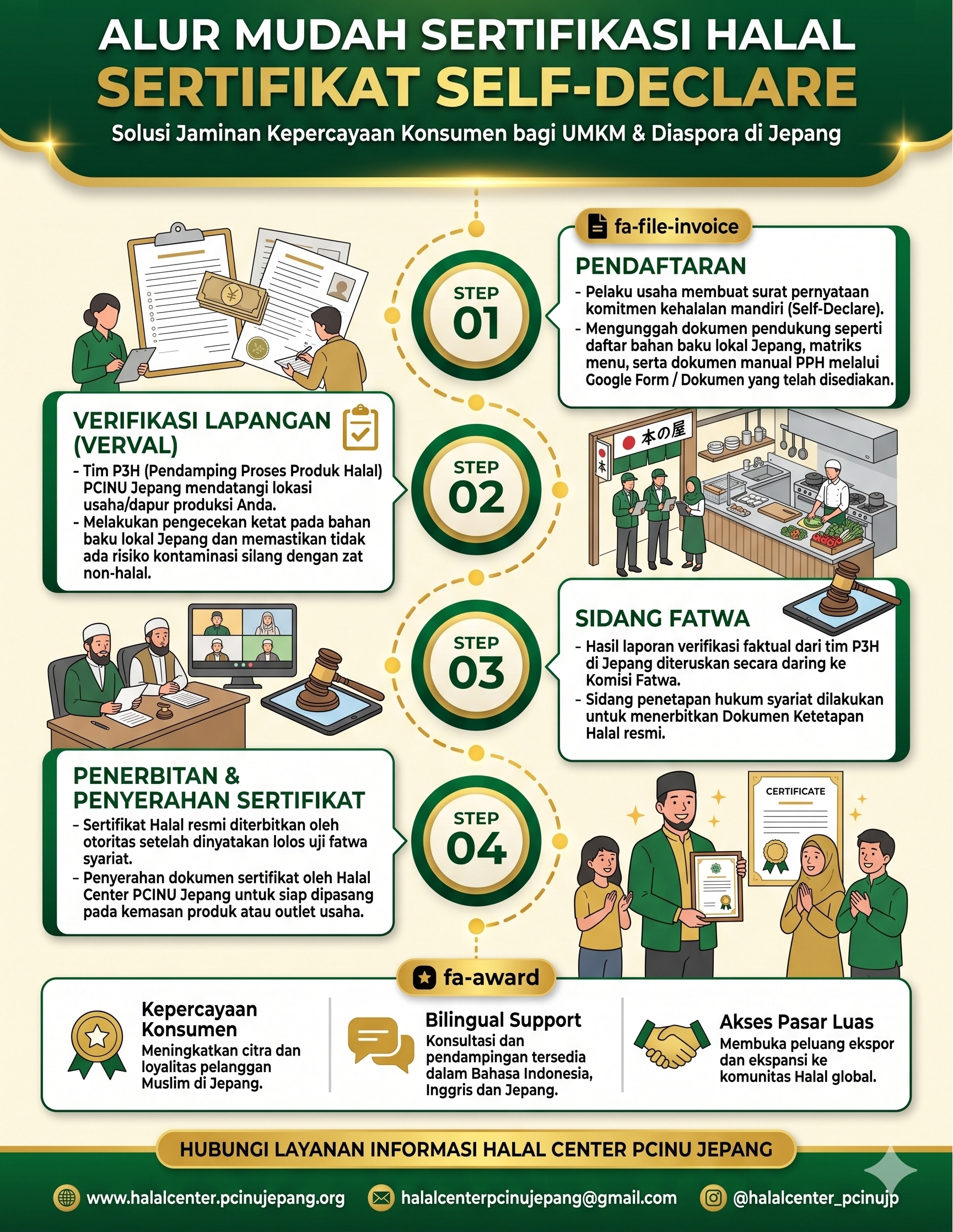
1. Application Submission
The applicant submits a halal certification application by completing the registration form and providing required documents, including company profile, product information, ingredient lists, and production process details.
The admission form can be accessed on this link https://s.id/RegistrasiSertifikasi.

2. Document Review
Halal Center NU Japan reviews all submitted documents to ensure completeness and compliance with halal standards, focusing on raw materials, additives, and production methods.
3. Halal Consultation & Guidance
Applicants receive guidance and consultation on halal requirements. This step may include recommendations for ingredient substitution, process improvement, and implementation of a Halal Assurance System.
4. On-site Audit / Inspection
A halal auditor conducts an on-site inspection of the production facility to verify that the manufacturing process, equipment, storage, and handling comply with halal requirements.
5. Evaluation & Religious Review
The audit results are evaluated, and the findings are submitted to the halal committee or religious authority for review and determination of the halal status.
6. Halal Certification Issuance
Once the product is approved, Halal Center NU Japan issues an official halal certificate, confirming that the product complies with applicable halal standards.
7. Monitoring & Renewal
Certified products are subject to periodic monitoring to ensure ongoing compliance. Certification renewal is required before the certificate expires.
5 Halal Certification Requirements
Halal certification requirements cover the entire supply chain, from raw material selection and production to storage, packaging, and distribution. The implementation of a Halal Assurance System (HAS) ensures that products are not only halal, but also thayyib—safe, hygienic, and compliant with Japanese food safety and quality standards—providing assurance to Muslim consumers in Japan and international markets.
1. Raw Materials and Additives
Halal-certified ingredients only (for animal)
No pork, alcohol, or haram derivatives
Verified suppliers & complete documentation
2. Production Process
Separate halal & non-halal lines or strict sanitation
Sharia-compliant cleaning procedures
Supervised by a trained halal supervisor
3. Storage and Packaging
Separate and clearly labeled storage
Halal-compliant packaging materials
Proper temperature & hygiene control
4. Distribution and Transportation
Clean, contamination-free vehicles
Documented transport and handling
Continuous halal integrity monitoring
5. Halal Assurance System (HAS)
Written halal policy (management commitment)
Appointed halal supervisor
Staff training & internal audits
Proper documentation & records
Organizational Structure
Halal Center PCINU Japan is committed to promoting halal awareness, facilitating halal certification processes, and supporting Muslim communities, businesses, and stakeholders across Japan.
Board of Advisors
Achmad Gazali, Ph.D.
KH. Agus Sulipan, A.Md.
KH. Ahmad Musyafak Suyuthi
Nasril Albab Mochamad, S.Ag., M.A.
Director
Muhammad Bisri Musthafa, Ph.D.
Shariah and Fatwa Division
Nasril Albab Mochamad, S.Ag., M.A.
KH. Ahmad Musyafak Suyuthi
KH. Ma’ruf Khozin
Halal Auditors
Drh. Megasari Marsela, Ph.D.
Anggita Aninditya P. P., S.M., CCSME., CBCC.
Muhammad Bisri Musthafa, Ph.D.
Nasril Albab Mochamad, S.Ag., M.A.
Khristian Agus Arianto, S.E., M.M.
Education and Training Division
Anggita Aninditya P. P., S.M., CCSME., CBCC.
Secretariat and Administration
Jimmy Ibrahim Ramadan